What this searcher actually needs
The practical search query for this article is appointment booking app with postcode scheduling. The person behind it does not only want customers to pick times online. They want bookings that already respect service areas, travel buffers, route clusters, and the reality of getting from one appointment to the next.
That matters commercially because postcode scheduling sits close to buying intent. When a mobile dog groomer, cleaner, hairdresser, therapist, mechanic, or installer searches for this, the pain is usually active: too much driving, too many edge area enquiries, too many manual checks, or a booking page that promises slots the business cannot profitably run.
The aim is simple. Use the postcode early enough that the booking flow can decide whether to accept, hold, redirect, or politely decline the request before the owner has to fix the day by hand.
Why postcode comes before availability
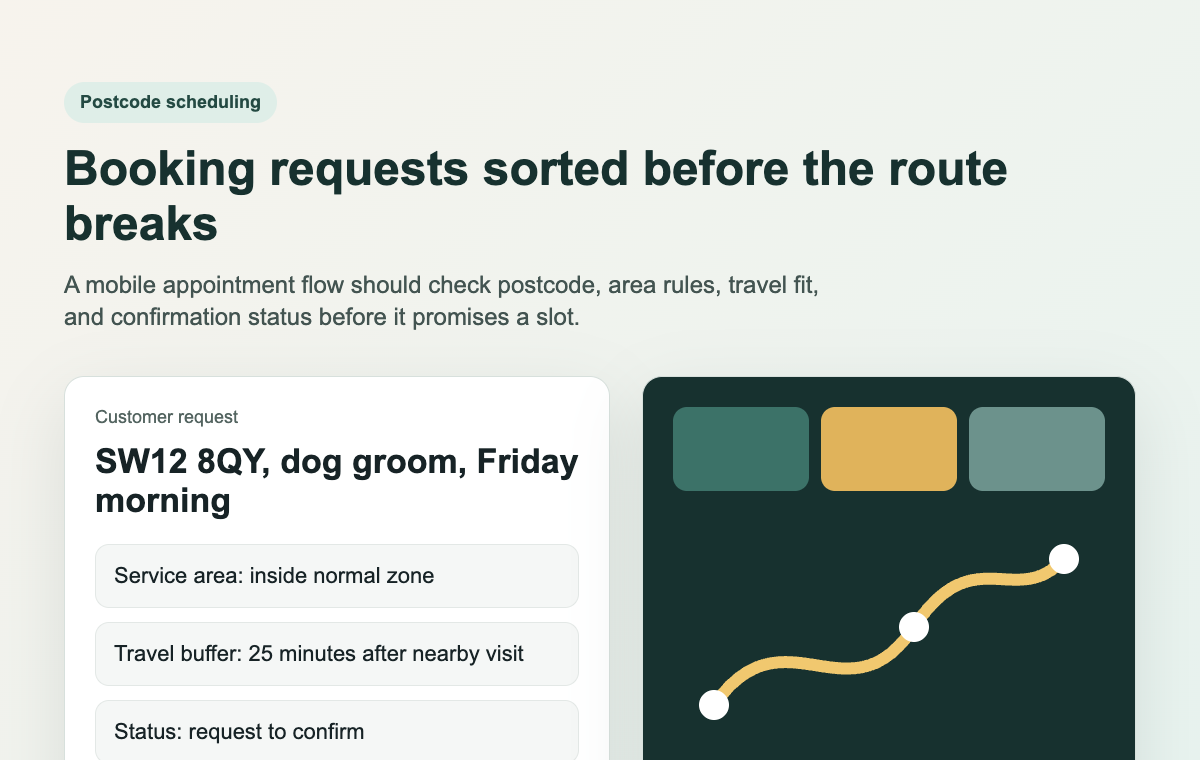
Generic appointment booking starts with available time. Mobile booking should start with fit. A 10 am slot can look free and still be wrong if it is outside the normal area, too far from the previous job, or too tight for access and parking.
The address pattern in the GOV.UK Design System is a useful reminder that addresses need structure, not one messy free text box. For mobile services, that principle affects operations as well as data quality. A complete address, postcode, flat number, parking note, and entry instruction can decide whether the appointment should be instant booked or manually reviewed.
Use the postcode as a scheduling signal, then use the full address as a visit signal. Structured address fields make it easier to collect the details people need to act on, while clear form structure keeps related questions together so the booking page does not feel heavier than it needs to be.
Postcode should decide
- whether the customer is inside the normal service area
- whether the request belongs to an edge area or premium travel zone
- whether instant booking is allowed or the owner should approve first
- whether nearby appointments should be suggested before isolated slots
- whether the customer should join a waitlist, make an enquiry, or see another page
Turn service areas into booking rules
Most mobile businesses already have service area rules, even if they are informal. They know the villages that work on a Tuesday, the outer postcodes that need batching, and the addresses that are only worth accepting with a minimum charge. The booking page should make those rules visible enough that customers do not receive false confidence.
The research run found operators and directories using location language constantly: mobile grooming pages list areas served, booking pages ask customers to enquire, and directories use town or postcode search as a discovery step. Those patterns show why postcode is not a small form field. It is part of the promise.
A mobile service area page such as a local mobile grooming page that lists areas served sets expectations before booking. A local enquiry page like a mobile dog wash business using booking enquiry language shows the other common pattern: gather interest first, then confirm fit manually.
Directory and discovery flows also teach the same lesson. Postcode based service discovery helps customers understand local availability, but the business still needs its own rule set for what happens after the customer is interested.
| Postcode result | Booking behaviour |
|---|---|
| Inside normal route | show the best available times and allow normal confirmation |
| Near an existing route | suggest route friendly windows first |
| Edge area | collect the request and confirm manually |
| Outside area | show a polite message, waitlist option, or customer demand route |
| Unclear address | ask for correction before confirming |
Keep the booking form light enough to finish
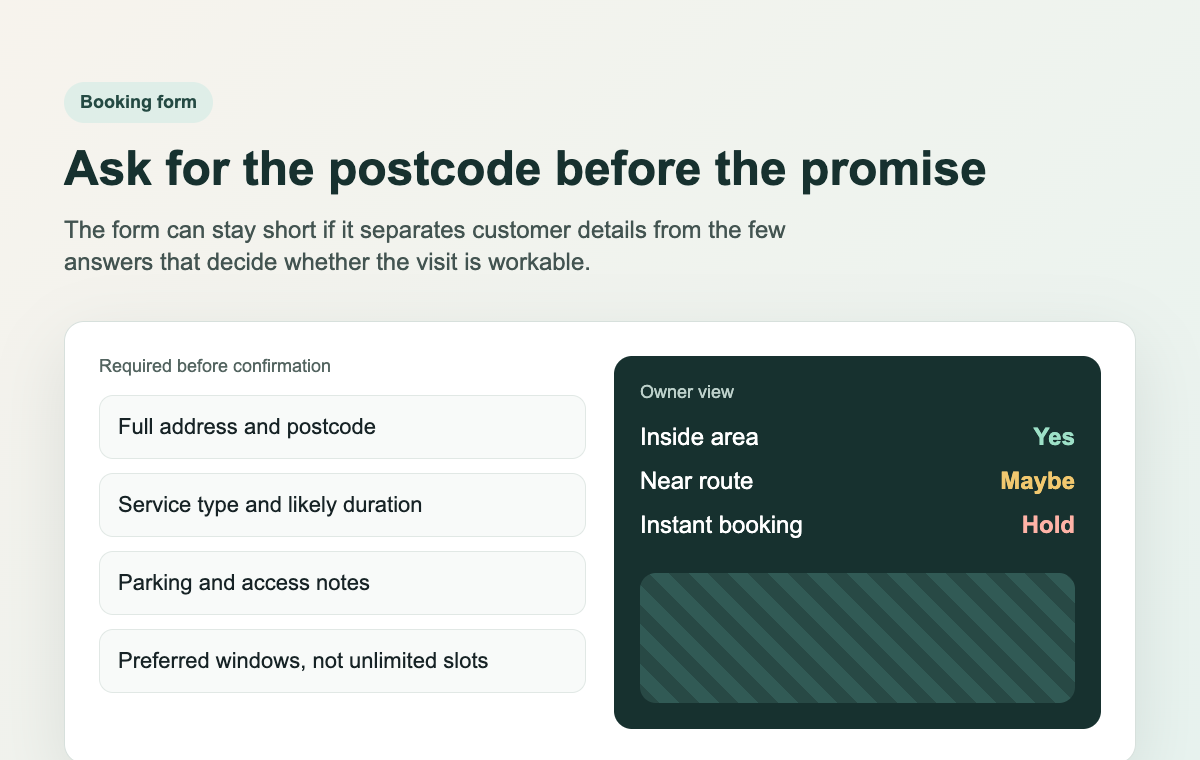
The answer is not to make the customer complete a huge form. The answer is to ask earlier for the few fields that change the scheduling decision, then collect softer details after the slot is safe.
A postcode scheduling form should feel like a useful filter, not an interrogation. Customers understand why you need their area, service type, access note, and preferred window when the questions are clearly tied to visit quality.
Address lookup and validation tools show why the small details matter. UK address validation can reduce mistyped or incomplete addresses, the Royal Mail postcode finder shows the standard address lookup behaviour customers recognise, and open postcode data can support area based checks when a product needs a lightweight lookup layer.
Fields to ask before confirmation
- postcode
- full address if the postcode is accepted
- service type
- preferred day or time window
- access and parking note where relevant
- client phone or email for follow up
- anything that changes duration, equipment, safety, or preparation
Route fit is more important than empty time
A mobile business can lose money while looking fully booked. The diary is full, but the postcodes zigzag, the route leaves awkward gaps, and the last job of the day carries too much travel for the value of the visit.
Postcode scheduling helps by making route fit part of the booking decision. It does not need to promise exact drive times. In many cases, broad area logic, normal buffers, and owner approval for edge cases are enough to prevent obvious mistakes.
Route tools and mapping references are useful background checks here. consumer route planners make travel time visible, multi stop route tools show why stop order changes the day, and Ordnance Survey location data explains the value of reliable geographic context. The booking app does not need to be a full mapping product, but it should respect the same operational reality.
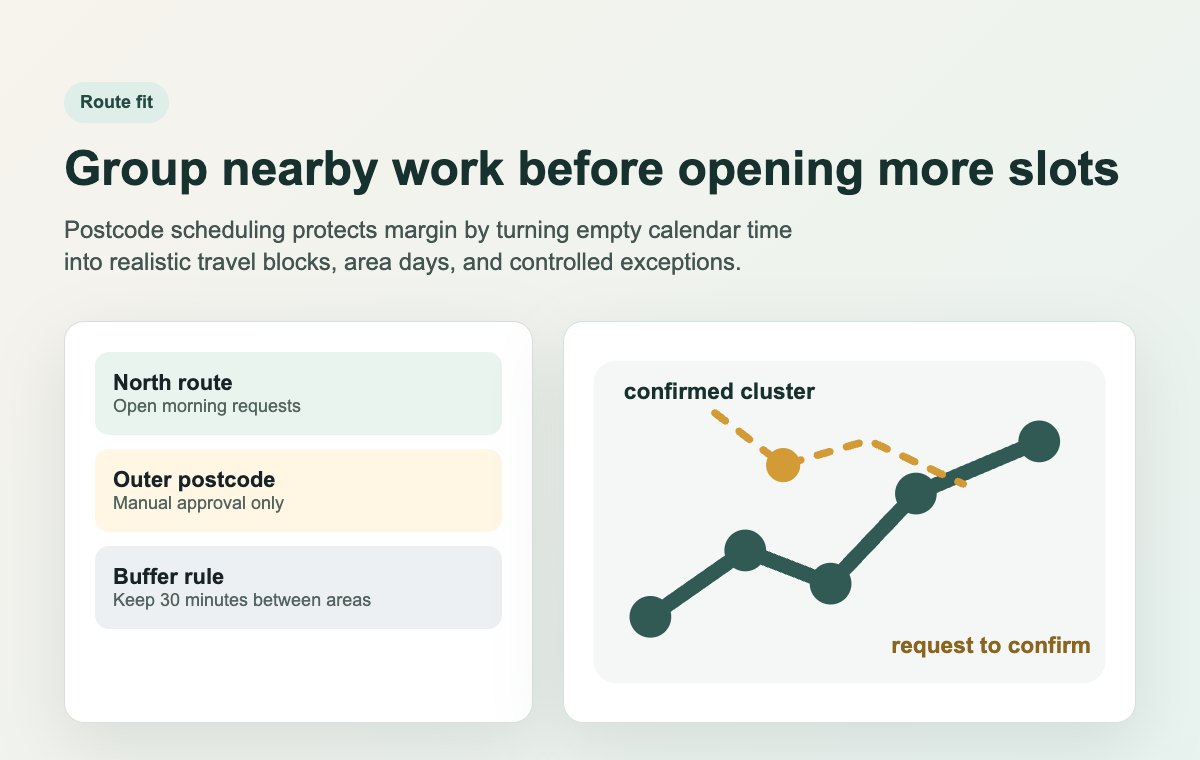
A simple route fit model
Group nearby work
Open more slots in areas where you already expect to be working.
Protect travel buffers
Keep realistic time between postcode clusters instead of treating each gap as sellable time.
Hold edge cases
Let customers request appointments outside the normal route, but do not confirm them instantly.
Review exceptions weekly
If an outer postcode keeps appearing, decide whether it needs a route day, travel fee, minimum booking value, or a polite no.
Use request to confirm where risk is high
Instant booking is powerful when the visit type, duration, address, and route fit are predictable. It is risky when the customer is outside the normal area, the service needs extra details, or the appointment could damage the rest of the day.
That is why postcode scheduling should have a request to confirm path. The customer still gets a clean online experience, but the owner keeps control when a slot needs human judgement.
Form usability guidance supports this kind of progressive decision. Well structured forms reduce avoidable effort and confusion, which matters when the customer only needs a short answer now and the business needs a fuller record later.
Low risk
Confirm automatically
Use this for normal area, normal service, normal duration, and enough buffer around nearby work.
- inside area
- known service
- clear address
Medium risk
Hold for owner approval
Use this for edge area, unusual service, tight route, unclear access, or high value appointments.
- edge postcode
- route check
- manual review
High risk
Decline or redirect kindly
Use this when the postcode is outside the service area or the request belongs in a different customer demand route.
- outside area
- waitlist
- customer request
Where Offlico fits
Offlico is useful here because postcode scheduling is not only a booking page issue. The postcode affects the client record, appointment timing, route planning, reminders, payment status, invoice context, and whether the job is worth repeating.
A generic calendar can show a gap. A mobile workflow needs to decide whether that gap should be offered to that customer, in that postcode, on that day.
Booking page
Collect the right first answer
Ask for postcode and service details before the customer sees slots that may not fit.
Smart scheduling
Protect route shape
Use route aware planning so nearby work is easier to group and edge cases are easier to review.
Client records
Carry the details forward
Keep address, access, parking, service notes, reminders, and follow up in the same workflow.
Frequently asked questions
What is postcode scheduling?
Postcode scheduling means using the customer postcode to decide whether an appointment should be shown, confirmed, held for review, or declined before the business promises a slot.
Should every mobile appointment be instant bookable?
No. Instant booking works best when the service, area, duration, access, and route fit are predictable. Edge areas and awkward route requests are usually safer as request to confirm.
What should the booking form ask for first?
Ask for postcode, service type, preferred timing, full address when accepted, and access or parking notes where those details affect travel, duration, or preparation.
Does postcode scheduling need exact routing software?
Not always. Many small mobile businesses can start with service area rules, postcode zones, buffers, and manual approval for exceptions before adding exact route optimisation.