What the query really means
The practical search query this article answers is MOT reminder software for garages UK. The person behind it is not just looking for a text message tool. They are trying to bring customers back before the MOT date passes, before the workshop diary goes quiet, and before the customer books somewhere else.
The search results show clear buying intent. Garage specific reminder pages, MOT reminder services, customer retention articles, and the official free MOT reminder service all point to the same behaviour: customers forget annual dates unless the next action is put in front of them at the right time.
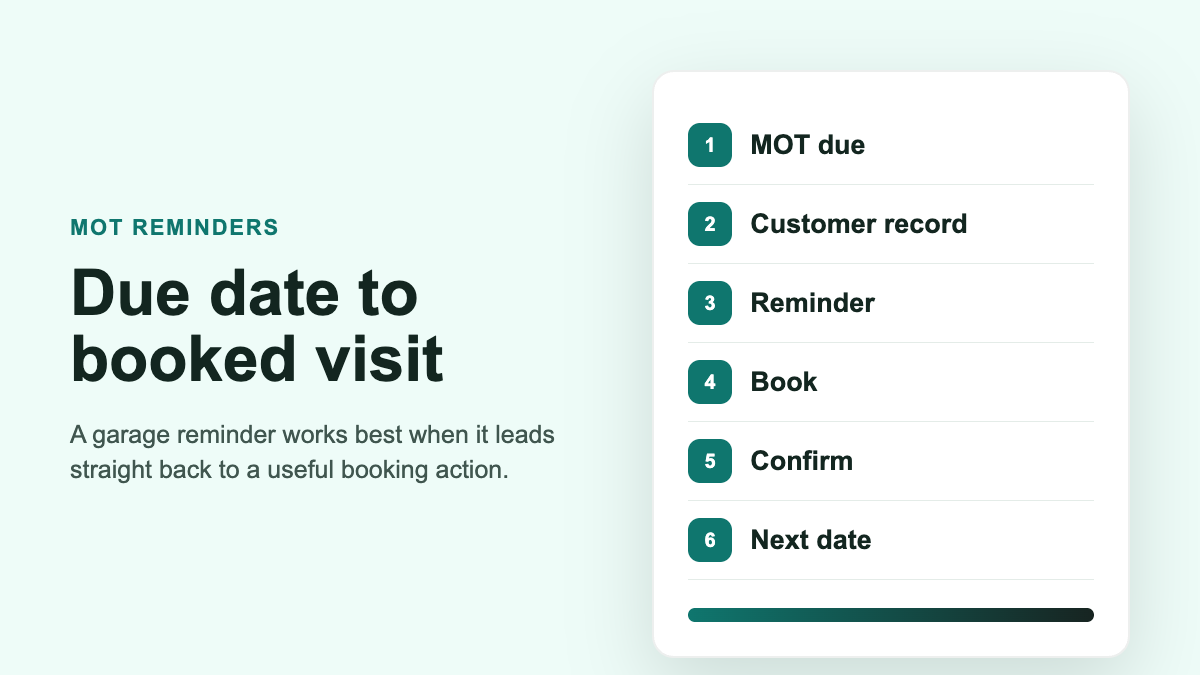
That matters commercially for Offlico because reminders are strongest when they are connected to the booking record. A garage does not only need to send a message. It needs the due date, vehicle, customer, consent, booking link, service notes, invoice status, and follow up to stay together.
Why one reminder is not enough
A single reminder can work for a careful customer, but it is fragile as a business system. The reminder may arrive when the driver is busy, the vehicle may need a service as well as an MOT, or the customer may need a quick route to book before the message is forgotten.
Official MOT reminder services prove that the due date problem is real. The public service lets motorists get reminders by text or email, while the service design work behind it describes the need to help owners get tested on time. For a garage, that creates an important distinction: the official reminder helps the driver remember, but it does not automatically bring the booking back to your workshop.
Garage facing tools in the research repeatedly frame reminders around repeat work, customer retention, SMS, email, phone, post, and automated service reminders. Examples range from automated MOT and service reminders by text, email, phone, and post to garage reminder workflows tied to customer retention. That is the commercial layer a garage controls.
| Weak reminder setup | Stronger reminder setup |
|---|---|
| One generic text | A sequence before the due date, with a clear booking action |
| MOT date only | MOT, service, cambelt, advisory, and customer notes where relevant |
| Manual chasing | Automated reminders that still allow staff review |
| No record trail | Reminder history attached to the customer and vehicle |
| No next step | Booking link, phone option, or request flow |
What the software needs to know
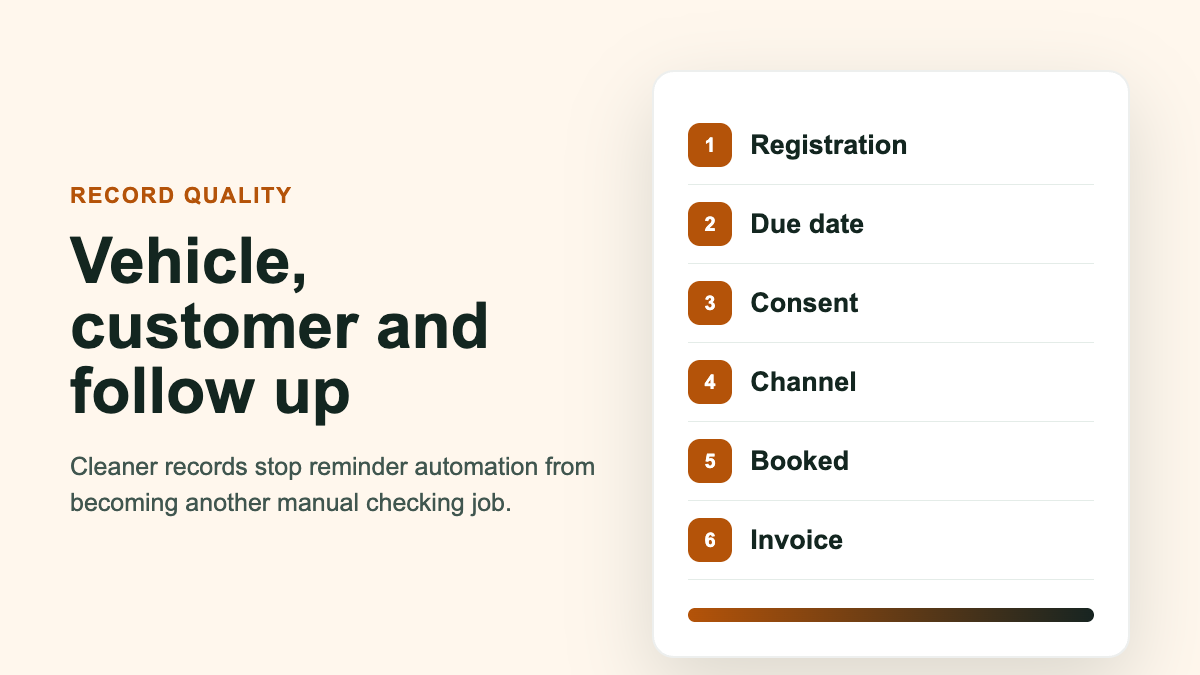
Good MOT reminder software starts with cleaner records. The minimum useful record is not just a name and phone number. It is the customer, vehicle registration, MOT date, service date if known, preferred channel, consent status, last visit notes, and whether the customer has already booked.
Customer facing reminder forms show the pattern clearly. A typical MOT and service reminder flow asks for vehicle registration, due dates, mileage, and contact details. Garage reminder tools then add the operational layer: customer reminders and staff reminders, due dates, and workshop follow up.
The practical test is simple. If a member of staff cannot tell who was reminded, when they were reminded, what they were asked to do, and whether they booked, the reminder system is still partly manual.
Fields worth keeping tidy
- Customer name and preferred contact method
- Vehicle registration and MOT due date
- Service due date, mileage, advisories, or cambelt notes where relevant
- Reminder consent and opt out status
- Reminder sequence and message history
- Booking status and appointment date
- Invoice, payment, or follow up status after the visit
Timing and channel choices
Reminder timing should be early enough to leave booking space, but close enough that the customer feels the deadline. That is why many garage reminder services talk about automated schedules rather than one manual send. The schedule should account for workshop capacity, parts or inspection lead time, and how far ahead regular customers usually book.
Channel choice matters too. SMS is immediate, email gives space for detail, phone can work for high value or older customers, and post still appears in parts of the garage reminder market. The best channel is not the cleverest one. It is the one your customer will act on without friction.
Service design sources around GOV.UK Notify helping DVSA remind motorists are useful here because they show reminders as part of a service, not as isolated messages. DVSA later reported millions of sign ups to the MOT reminder service, which reinforces how normal reminder behaviour has become for motorists.
A practical MOT reminder sequence
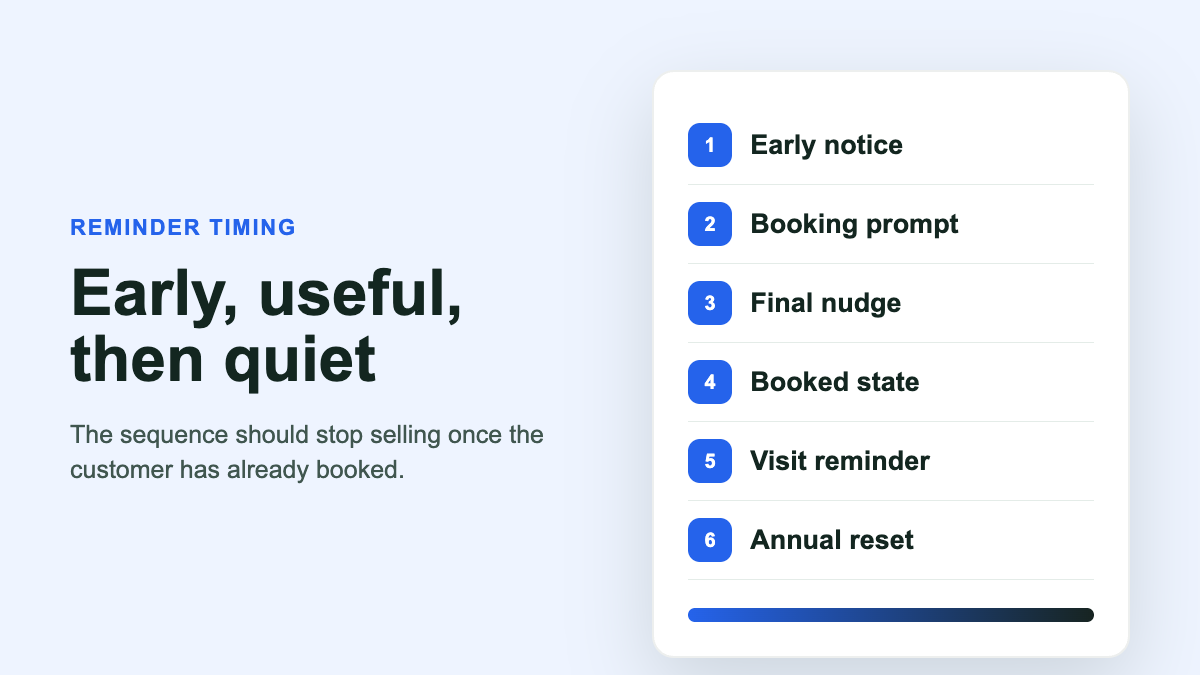
Early reminder
Tell the customer the MOT or service date is approaching and give the booking route.
Booking prompt
Send a shorter reminder when diary space is still available.
Final nudge
Use a concise message near the deadline for customers who have not acted.
Booked state
Stop the sales reminder once the appointment is booked and switch to appointment preparation.
After visit
Update the record so the next annual reminder is not rebuilt from scratch.
Avoid awkward reminder mistakes
Reminder automation can create trust problems if it is disconnected from real records. A customer should not be chased after they have already booked, sent a service reminder for the wrong vehicle, or given a booking link that has no useful workshop availability.
This is where a garage should compare workflow, not just message credits. MOT specific tools, garage CRM systems, and workshop platforms all approach the problem differently. Some focus on SMS and email MOT reminders, some on text reminders inside a garage diary, and some on automated reminders inside broader garage management. The right choice depends on whether the garage mainly needs reminder sending or a connected repeat work process.
The risk is not only admin. Repeated wrong reminders teach customers to ignore the next message. Practical garage reminder guides keep coming back to repeat work and customer retention, while consumer guidance around late MOT risks shows why timing can matter to the customer as well as the garage. A clean opt out, accurate due date, and correct booked state protect the usefulness of the whole system.
| Mistake | Why it matters | Better rule |
|---|---|---|
| Reminder after booking | It makes the garage look disorganised | Suppress repeat prompts once booked |
| Wrong vehicle | It damages trust quickly | Keep registration and customer records linked |
| No booking route | The customer has to remember later | Include a booking link or clear phone option |
| Too late | The diary may already be full | Start while useful slots still exist |
| No opt out | Customers need control | Keep consent and opt out status visible |
Where Offlico fits
Offlico is not trying to replace specialist MOT testing systems. Its useful angle for mobile mechanics, small workshops, and appointment led service businesses is the connected workflow around the appointment.
A reminder should lead somewhere. In Offlico, the booking, customer record, reminder, note, invoice, and follow up can sit closer together, so the next action is not split across a diary, spreadsheet, inbox, and text thread.
For garage like workflows, the same principle applies beyond MOT dates. Annual servicing, follow up inspections, repeat maintenance, and customer rebooking are all easier when reminders are connected to the work record.
Final takeaway
The best MOT reminder software is not just the one that sends the cheapest text. It is the one that keeps annual dates, customer records, booking actions, and follow up clean enough that repeat work does not depend on memory.
Start with the operator problem. Decide what date needs reminding, what channel the customer will act on, how they will book, how the record will update, and how staff will avoid chasing the wrong customer at the wrong time.
What should MOT reminder software do for a garage
It should store MOT or service due dates, send reminders through useful channels, show who has booked, keep consent and opt out status visible, and connect the reminder to the customer and vehicle record.
Is the free GOV.UK MOT reminder enough for garages
It helps drivers remember their MOT date, but it does not automatically return the booking to a specific garage. Garages still need their own customer reminder and booking follow up workflow.
When should garages send MOT reminders
Send early enough to leave diary space and a clear booking route, then stop reminder prompts once the customer has booked. The exact timing depends on workshop capacity and customer booking habits.