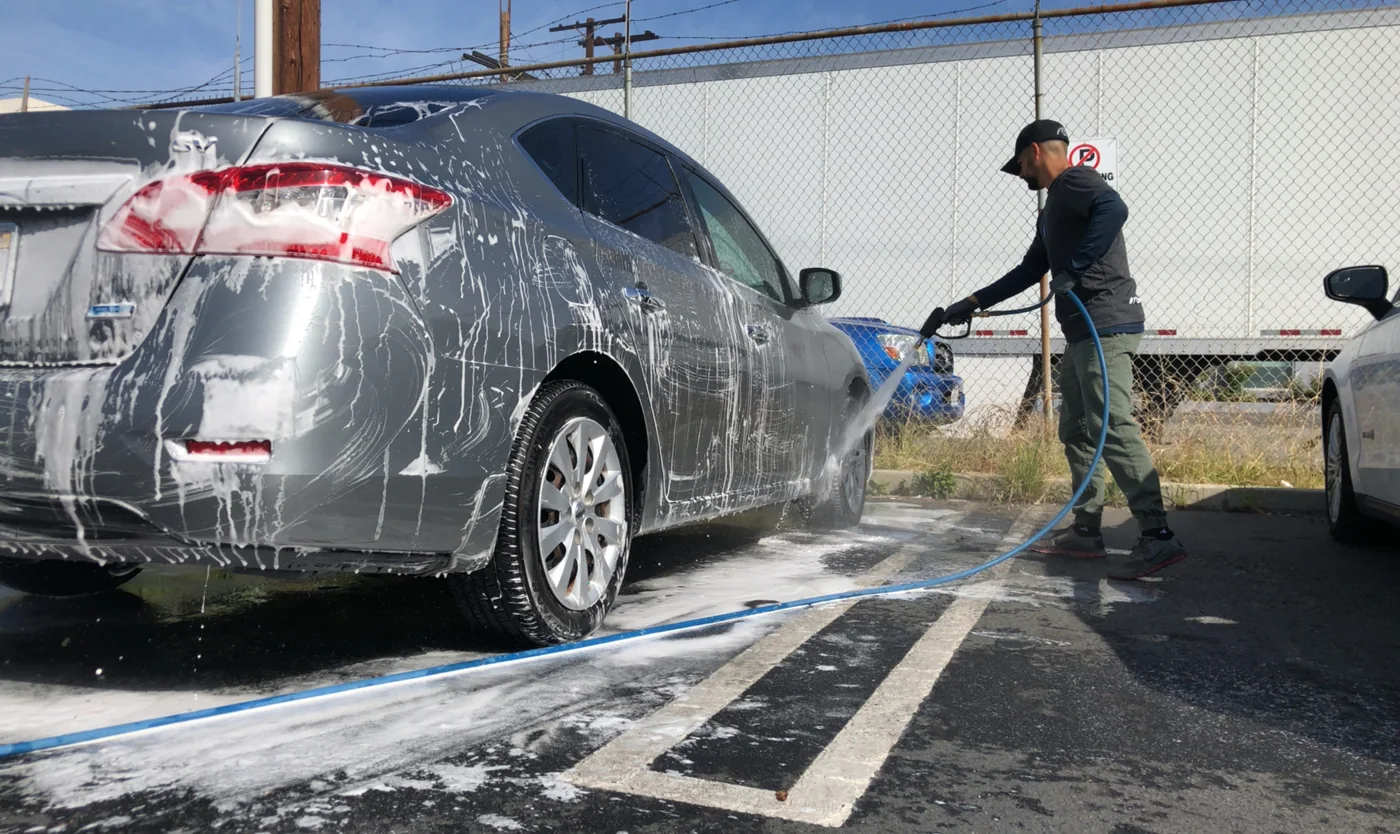
A customer offers a driveway and a tap. That settles where the car can stand and where clean water comes from, but it does not settle where used water will go. Before accepting a wet wash, a mobile valeter needs to look beyond the vehicle: the slope of the surface, nearby gullies, the route across the pavement and the destination for any water collected.
This guide is a practical decision sequence for a visit, not a blanket rule that every domestic driveway has the same drainage. The environmental guidance cited below is for England where stated. Elsewhere in the UK, check the relevant regulator and sewerage provider for the proposed method and location. The useful starting question is simple: can you explain the whole path of the wash water before opening the hose?
Decide what the job needs before the visit
Ask where the vehicle will be parked and whether the proposed surface is level, sloping, paved or porous. Ask for photographs of the whole wash area, not just the car. A photo can show a gully or the edge of a driveway, but cannot prove where a pipe leads. If access is shared or the wash space is on a public edge, find out whether the working area can be kept clear without sending water across a neighbour’s land or a walking route.
Write down the intended wash method. A full pressure wash, a careful low water wash and an interior only clean create different amounts and types of liquid, but “less water” is not a disposal plan. A practical mobile valeting site guide suggests checking the slope, drain positions and likely runoff path before unloading. Treat that as a useful operator checklist, then verify the actual site rather than assuming a familiar driveway will behave the same way.
Trace the water on arrival
Walk the perimeter of the vehicle before setting up. Look for a fall towards a road gully, an open drain, a garden edge or another property. Consider where water will travel when it leaves the tyre area, not just where the first puddle forms. Rain, a different parking position or a blocked edge can change the path from the one discussed at booking. If the proposed route cannot be contained, pause the wet wash.
The Environment Agency’s business pollution guidance lists vehicle washing among activities that can produce contaminated water. It distinguishes surface water drainage, which can lead directly to the environment, from foul or combined drainage. The guidance says only clean water should enter a surface water drain or soakaway. No page can identify the pipes under a particular customer’s driveway for you. A grate is a question to investigate, not proof of a safe destination.
Check the destination, not just the drain cover
Do not treat a customer’s “you can use the drain” as confirmation of its type or of permission to discharge. In England, the Environment Agency says contaminated water can be collected for reuse, on site treatment or removal by a registered waste carrier, or sent to a foul or combined drain with water company permission. The correct route depends on the operation and the receiving system. If the proposal relies on a sewer connection, describe the wash water and ask the relevant sewerage provider what permission applies before relying on it.
For its network, Thames Water explains that trade effluent discharge into a public sewer needs its consent, and it lists commercial car washes among activities that would normally require an individual assessment. That example is not a decision about every one off domestic driveway visit. It does show why a domestic customer’s agreement and a visible drain cover cannot substitute for a check with the provider. Southern Water also says trade effluent discharge into its public sewer needs consent. These are provider specific instructions, not blanket rulings for the customer’s particular drain. Keep the answer and any conditions with the job record; if the answer is still unknown on arrival, do not guess.
Make collection a complete plan
A mat, barrier or portable pump helps only if it actually catches the water produced at this site and there is somewhere acceptable for that water to go next. Check that the surface lets the equipment seal or sit correctly, that runoff cannot escape round a wheel or kerb, and that the receiving container has enough capacity for the planned service. Follow the kit maker’s instructions. Leave the route past the car usable and keep electrical equipment away from the wet area.
A mobile fleet washing operator describes collecting wash water into onboard tanks for later disposal when site drainage is unsuitable. Its depot scale equipment is not a ready made answer for a small domestic valet, but the process has a transferable lesson: containment and onward disposal belong in one plan. If your own equipment cannot be deployed at the customer’s location, a promise to collect water is not enough. Recheck the arrangement if the customer moves the car or the weather changes.
Change the method before water starts moving
A site that fails the water path check does not automatically mean losing the booking. Explain the specific obstacle and offer only options you can actually deliver: a different position with a confirmed arrangement, a lower water or interior only service where residues are still handled properly, or a different suitable location. If none is workable, reschedule or decline the wet wash. Do not quietly improvise a discharge route halfway through the job.
For example, if the only parking space slopes towards a street gully and you cannot contain the planned wash water, tell the customer before unloading: “I can do the interior today, but I cannot do the wet exterior wash in this position. We need a suitable wash area and disposal arrangement first.” That is a hypothetical script, not a report of a customer incident. It gives the customer a choice while keeping the decision tied to the actual site.
Leave a record the next visit can use
Record the parking position, the observed water path, the method used, the collection arrangement and any permission or advice received. If the plan changed, note what was agreed and what was not done. A short customer message should say what service was completed and whether a future wet wash needs a new location or method. Avoid writing “drainage approved” unless the relevant provider has actually confirmed it for the proposed arrangement.
For a mobile business, this is a small part of visit planning rather than a new technical feature to buy. Keep the site decision alongside the booking and customer notes so the next worker does not have to reconstruct it from memory. The aim is not a complicated form. It is a dependable answer to three questions before the first rinse: where will the water travel, how will you control it, and where will it end up?